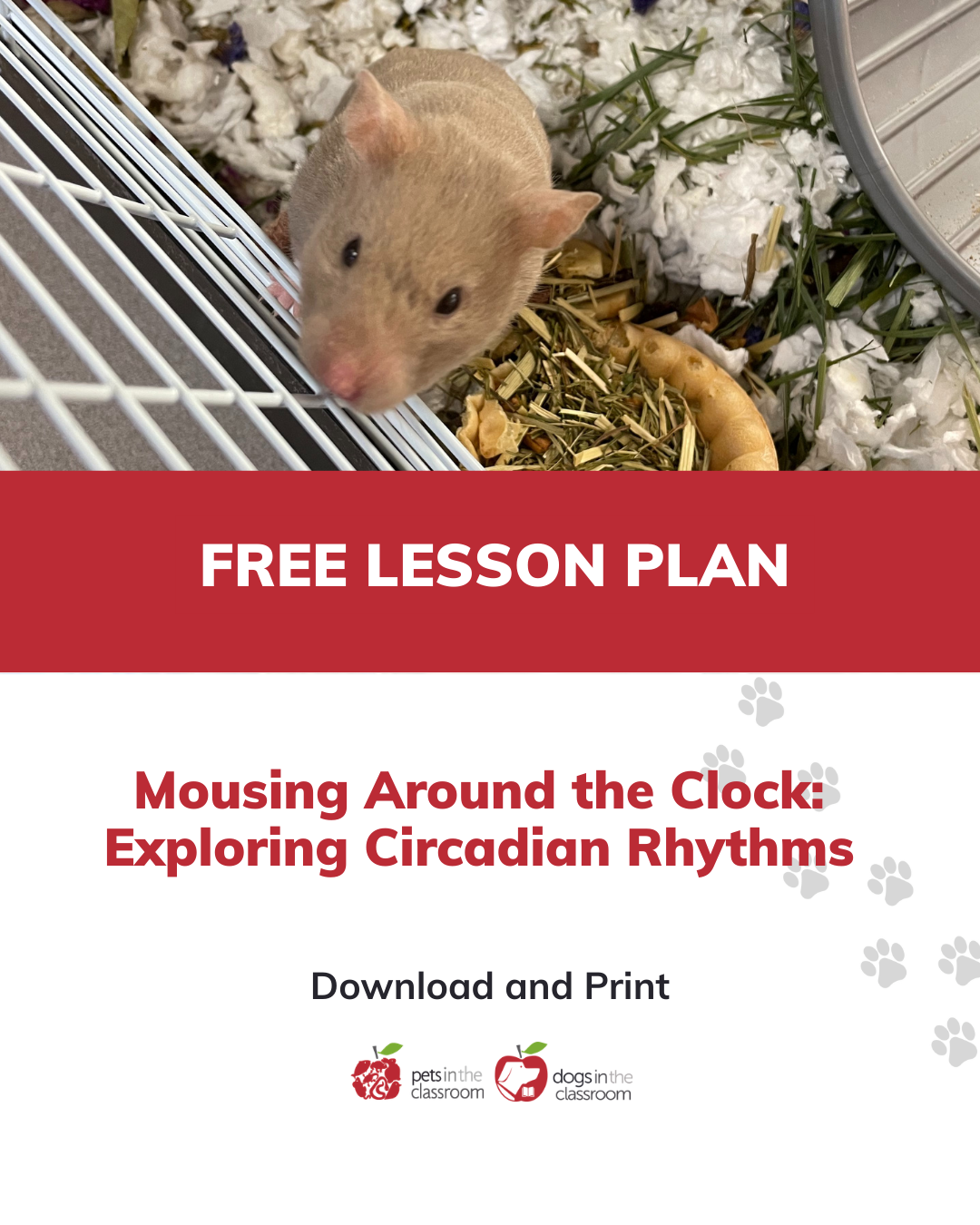
Understanding how animals respond to their environment is a key part of middle school science. Pets in the Classroom’s free, standards-based lesson, Mousing Around the Clock: Exploring a Mouse’s Circadian Rhythm is a hands-on, standards-based lesson for grades 6–9 that helps students investigate biological rhythms through real observation, data collection, and experimentation.
While the lesson is written using a classroom mouse, it can easily be adapted for other small animals such as guinea pigs, hamsters, gerbils, or similar species, making it a flexible option for classrooms with different pets.
What This Lesson Teaches
This lesson centers around a guiding question:
How does an animal’s circadian rhythm influence its activity patterns?
Students learn to:
- Understand what circadian rhythms are and how they regulate behavior
- Explore how light and dark cycles affect animal activity
- Design and conduct a controlled experiment
- Collect, graph, and analyze real data
- Identify variables and evaluate results using evidence
The lesson integrates science, math, technology, and literacy, supporting NGSS-aligned middle school learning.
How the Lesson Works
The lesson is structured in three parts:
- Introduction to Circadian Rhythms
Students connect the concept to real life (jet lag, sleep patterns) and learn how light influences biological clocks in both humans and animals. - Baseline Data Collection
Students track how much an animal moves during light and dark periods over several days, establishing normal activity patterns. - Experimental Investigation
Working in small groups, students test how changes in light exposure affect activity levels, then analyze and graph their results.
Student worksheets and a lab report rubric provide clear structure while allowing room for inquiry and discussion.
Materials Needed
Materials vary by animal but typically include:
- A classroom small animal (mouse, guinea pig, hamster, gerbil, etc.)
- Exercise wheel or movement-tracking method
- Simple measuring or tracking tools
- Student worksheet and analysis pages
The lesson can be scaled up or down depending on classroom setup and available resources.
Why Teachers Use This Lesson
Mousing Around the Clock gives students an authentic look at how scientists study behavior and environmental influences. It encourages careful observation, critical thinking, and responsible animal care—while giving teachers flexibility to adapt the lesson to the pets they already have.
This free lesson plan is part of the Pets in the Classroom library of standards-based resources designed to help teachers teach science through real-world experiences.
Explore the lesson plan at petsintheclassroom.org.