At Pets in the Classroom, our mission has always been simple yet profound: to enhance students’ educational and personal development through interaction with pets in their classroom. Every day, we hear from teachers who witness incredible breakthroughs—shy students finding their voices, anxious kids finding a sense of calm, and entire classrooms learning the true meaning of empathy and responsibility.
But we didn’t just want to rely on heartwarming stories. We wanted to see the measurable, sweeping impact our program is having across the United States and Canada.
That is why we are thrilled to share the results of our 2026 Teacher Survey. With over 1,100 educators participating, the data speaks volumes: 99% of respondents affirmed that having a classroom pet is an overwhelmingly positive experience. From boosting attendance to decreasing disciplinary measures, these companion animals are acting as silent co-teachers, emotional support systems, and catalysts for academic engagement.
Below, you’ll find our official press release detailing the statistics, real-world breakthroughs, and proof of how a small pet can make a monumental difference in a child’s life.
Survey Shows Classroom Pets Enhance Learning Experience for Students
A survey produced by the Pets in the Classroom grant program shows the impact the program has had on students during the 2025–26 school year.
FOREST HILL, MD (June 9, 2026) – The Pets in the Classroom grant program is pleased to announce the results of its 2026 teacher survey.
The survey, which polled teachers across the United States and Canada who have received funding for classroom pets through their grant program, received an overwhelming response, with over 1,100 teachers participating.
The survey findings emphasize the numerous ways that classroom pets have a positive impact on students, from enhancing social-emotional development to improving academic engagement to fostering a love for learning.
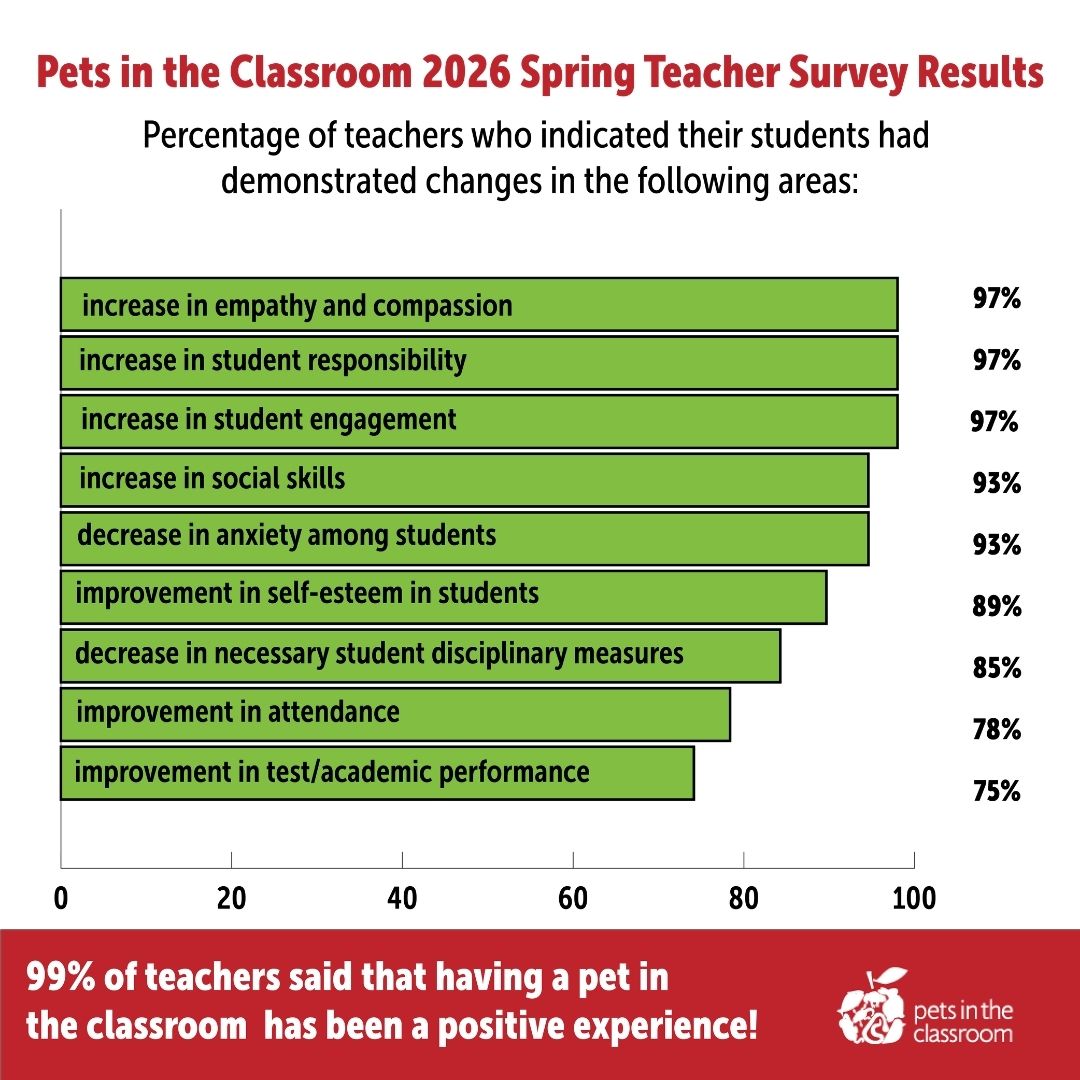
 Ninety-nine percent of respondents said that having a pet in the classroom has been a positive experience, and teachers reported that interacting with classroom pets helped improve attendance, reduce anxiety levels, foster empathy and compassion, enhance test and academic performance, develop social skills, boost self-esteem, and decrease disciplinary measures.
The data, coupled with the comments that teachers shared through the survey, demonstrate the impact classroom pets are making:
Attendance: 78 percent of teachers saw an improvement in attendance due to their classroom pet. One teacher shared, “I had a student come into my classroom from the foster care system. Before my class he did not attend school regularly and when in school would very rarely be in the classroom due to behavior. Since being in my class this year, he has had almost perfect attendance and that is in no small part due to our class pet, our axolotl, Bubbles! He loves to greet Bubbles daily, do kind things for Bubbles, show Bubbles how to listen, do work, etc.”
Decreased anxiety: 93 percent of teachers observed a reduction in student anxiety. A teacher noted, “Rexi is officially our school-wide emotional support animal. I would never have dreamed the calming effect a lizard can have on children. Teachers from just about every class in the school have brought or sent a student when they were dealing with some really tough stuff. After holding Rexi for a little while, they get a deep calm.”
Empathy/compassion: 97 percent of teachers saw an increase in empathy and compassion. One teacher said, “Students often gathered near the tank during independent work time or when they needed a quiet moment to reset. It also opened the door for meaningful conversations about kindness, empathy, and caring for living things.”
Test/academic performance: 75 percent of teachers saw an improvement in academic performance. One teacher shared, “Academically, [our bearded dragon] made science feel real. When we talk about habitats or adaptations, students connect it directly to Tupaco, which keeps them engaged and curious. One of my favorite moments was seeing a student who usually struggles to step up, research how to care for Tupaco, and confidently share what they learned with the class. That kind of growth has been amazing to see. Tupaco has truly brought our classroom closer together and made learning more fun and meaningful.”
Responsibility: 97 percent of teachers saw an increase in student responsibility. “Having a class fish created a sense of responsibility and teamwork as students worked together to help care for it each day. Even some of my quieter students became more confident as they shared observations and reminded classmates about feeding schedules and tank care.”
Self-esteem: 89 percent of teachers observed an improvement in student self-esteem. One teacher wrote, “One of the children entered the program very shy and timid. Interacting with ‘Birdy’ and helping to care for our class pet definitely made him feel more comfortable and built his self-esteem.”
Increased social skills: 93 percent of teachers noted stronger social skills in their students. “A very quiet student became highly engaged in caring for the fish and gradually started interacting more with peers through shared responsibility and conversations about the tank. We also incorporated the fish into learning activities like counting, observation, and storytelling. It was amazing to see how a classroom pet supported social confidence, empathy, and student engagement in learning,” one teacher said.
Student engagement: 97 percent of teachers reported increased engagement. One teacher shared, “Our classroom pet has helped students become more responsible, caring, and engaged in the classroom. Many of my students are naturally shy, but interacting with the pet has encouraged them to communicate more, work together, and show empathy. Students enjoy helping with simple care routines, and it has also sparked curiosity and learning through observation, discussion, and classroom activities connected to science and social-emotional growth.”
Decrease in necessary student disciplinary measures: 85 percent of teachers saw a decrease in student disciplinary issues. “I have a student that struggles with behavior every single day and he took on the responsibility of feeding our pet. Every day he takes care of them, and I have seen a dramatic improvement in his behavior in class,” a teacher explained.
The statistics, coupled with the heartwarming comments shared by teachers about how pets are transforming their students’ lives, truly show the impact of the program. One teacher stated, “In my class, many of my students come from low-income families, and having a pet in the classroom provides them with meaningful experiences they may not otherwise have access to. A classroom pet helps teach responsibility, compassion, patience, caring, and other important life skills. Students learn the importance of teamwork and daily routines through feeding, cleaning, and helping care for the pet, while also developing empathy and a sense of connection. The pet also creates a positive, comforting, and engaging learning environment that many students look forward to each day. It brings so much joy and enrichment to my students and supports both their social-emotional growth and learning experiences!”
The Pets in the Classroom grant program was established by the Pet Care Trust with the knowledge that classroom pets can be a valuable teaching tool that many teachers do not have access to because of a lack of funding.
Since the program’s inception in 2010, Pets in the Classroom has issued over 279,681 grants. This means that an estimated 11.1 million children have experienced the joys and benefits of pet care through the program.
As teachers look for more ways to support their students in the upcoming school year, the Pets in the Classroom grant program is ready to help by providing funding for classroom pets to Pre-K–12th grade teachers across the U.S. and Canada beginning July 2, 2026.
Learn more about the Pets in the Classroom grant program by visiting www.PetsintheClassroom.org.